
Competitions
Top Science Fair Project Ideas for High School Students
Discover top science fair project ideas for high school students that stand out to judges, build real research skills, and strengthen college applications.
Read Now
4
minute read


.webp)
Begin your journey to exceptional projects
Is Regular Decision a bad choice for college applications? Learn the pros, cons, deadlines, and when applying RD may be the smartest admissions strategy.


Regular Decision vs Early Decision is one of the most important strategic choices students face during the college admissions process. While Early Decision promises earlier results and smaller applicant pools, Regular Decision often provides additional time, flexibility, and strategic advantages that can strengthen an application and improve long-term outcomes.
College admissions timelines shape far more than just deadlines. They influence how students present their academic progress, how they build extracurricular profiles, and how they evaluate financial aid offers. Understanding how Regular Decision compares to Early Decision and Early Action allows students to approach the process deliberately rather than reactively.
Not an application season has gone by where I have not received the same question from nervous parents and students.
“Should we apply Early Decision? Wouldn’t that be better?”
No doubt, the very term Early Decision implies advantages that the seemingly inferior Regular Decision cannot offer. After all, who wants to be just “Regular”?
With the promise of competing against a smaller pool of candidates and getting done with the nerve-wracking admissions process early, many students commit themselves to ED without considering all that Regular Decision (RD) has to offer.
The truth is that Regular Decision provides invaluable time, flexibility, and strategic advantages that can help applicants strengthen their candidacy and make more informed decisions.
In this guide, we will unpack what Regular Decision entails, examine its pros and cons, and explore some of its overlooked benefits for students looking to maximize their college admissions outcomes.
Before examining the advantages of Regular Decision, it helps to compare RD with the other common admissions timelines.
Early Action is a non-binding application option. Students apply early, usually by November 1 or November 15, and receive their admissions decision by mid-December.
If admitted, students are not obligated to attend and may still apply to other colleges.
Early Decision is a binding admissions agreement.
Like Early Action, the deadline typically falls in early November. However, if a student is accepted through Early Decision, they must withdraw all other college applications and commit to attending that institution.
This option is usually best suited for students who have a clear first-choice college and a strong academic profile early in senior year.
Regular Decision is the standard application timeline used by most universities. Deadlines typically fall between January 1 and January 15, with decisions released between late March and early April.
Regular Decision allows students additional time to:
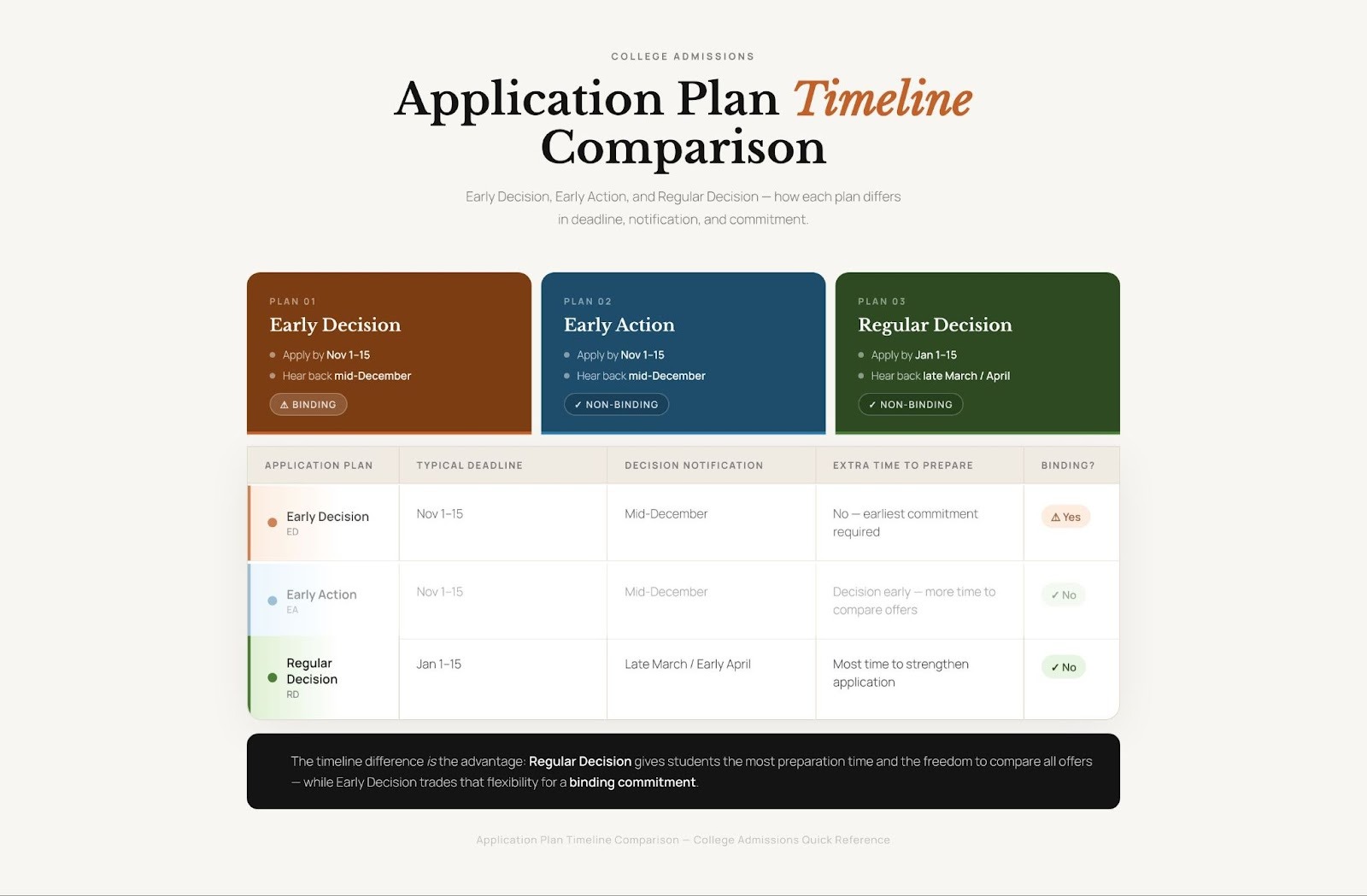
The difference in timeline is precisely where Regular Decision’s primary advantage lies: time.
Anytime a student eagerly asks me about ED or EA, I remind them of the story of the tortoise and the hare.
I like to imagine that the hare was not only overconfident but also probably anxious, while the tortoise was likely in a much calmer headspace.
It is much the same in your decision between RD and ED.
Ultimately, the fundamental advantage of Regular Decision over Early Decision is time.
Applicants receive additional months to:
Financial aid comparison alone can be a decisive factor for many families.
In essence, Regular Decision gives students more breathing room and flexibility to put their absolutely best foot forward in the application process.
There is another factor that too many students simply do not account for when choosing between Regular Decision vs Early Decision, one that applies to every applicant from every background: fatigue.
As I tell students each year, the application process is taxing, opaque, draining, and just downright scary.
Consider what may happen if you receive no offer, or one with insufficient funding, in the Early Decision round.
You would have worked harder and faster than RD applicants, and suddenly you must prepare multiple new applications on a much tighter timeline.
Students rejected in Early Decision and forced to reapply through Regular Decision often face a disadvantage. They are more fatigued, less enthusiastic, and working under a compressed timeline.
In my experience working with students, the first round of applications is usually the strongest. Attention to detail and enthusiasm tend to fade as the process stretches on.
Have I seen applicants come up short in ED and achieve amazing results in RD? Certainly.
But I have also seen too many students sick with anxiety and reeling from disappointment in January, submitting applications half-heartedly.
Regular Decision is not perfect, and understanding its limitations is crucial for students building an admissions strategy.
One of the most commonly cited concerns about applying Regular Decision is that acceptance rates are often lower compared to Early Decision.
At highly selective institutions, a significant portion of the incoming class may be filled during the early round. For example, Harvard typically admits roughly 40 percent of its class through early admissions, meaning the remainder of the class is filled during the Regular Decision round.
However, these statistics can be misleading.
Early Decision pools are often smaller and more targeted. They frequently include legacy applicants, recruited athletes, and students with a particularly strong institutional fit.
Because of this, Early Decision acceptance rates may appear higher not because admission is easier, but because the applicant pool is more self-selecting.
Despite this, universities still admit large portions of their incoming classes through Regular Decision.
Another downside of Regular Decision is the timeline.
While Early Decision and Early Action applicants typically receive responses by mid-December, Regular Decision applicants often wait until late March or early April.
This creates a compressed decision window before the May 1 national enrollment deadline.
Students therefore have only a few weeks to compare offers, evaluate financial aid packages, and finalize their college choice.
While Regular Decision comes with logistical disadvantages, these can be managed with the right approach.
Use the fall semester to strengthen your academic performance, especially if earlier semesters left room for improvement.
Work closely with your school counselor or a trusted mentor to build a balanced college list containing reach schools, target schools, and safeties.
As I tell my students, if you want to go to college, make sure your list is both sufficiently long and contains no university you would be unwilling to attend.
If you are participating in a fall research or innovation program, incorporate those experiences into your essays or activities list to showcase your most recent accomplishments and demonstrate continued intellectual growth.
Do not let the name fool you. There is nothing inherently superior about applying early.
Students are understandably drawn to stories of applicants who relax comfortably in January knowing they have already secured a place at their dream school.
But the reality is more nuanced.
Students are often better served by focusing on the strength and authenticity of their application rather than rushing to meet an earlier deadline.
In essence, it is usually better to find the right window for the application, rather than forcing the application to fit the window.
Regular Decision acceptance rates are often lower than Early Decision rates, but this difference reflects the composition of the applicant pool rather than a fundamentally different admissions standard.
Yes. Students admitted through Early Decision are expected to withdraw all other college applications and enroll at that institution.
Most Regular Decision deadlines fall between January 1 and January 15, with decisions released in late March or early April.
No. Early Decision is best suited for students with a clear first-choice college and a strong academic profile early in senior year. Students who want more time to strengthen their applications through research, competitions, or projects may benefit more from Regular Decision.




.webp)

.webp)
