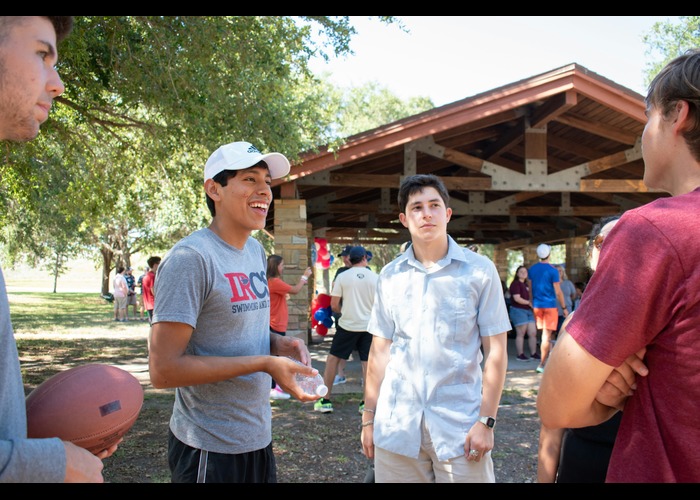
Academic Decathlon, often shortened to AcDec or AcaDec, is a team academic competition for high school students. A full team has nine students from one school, three in each of three GPA divisions. Every student competes in the same ten events: seven multiple-choice tests, an essay, a speech and an interview.
To compete, join your school's team or start one through your state's Academic Decathlon program. If you're still weighing AcDec against other activities, start with our guide to extracurricular activities in high school.
Facts checked October 2026. Rules, prices and dates come from 2026-27 documents published by the United States Academic Decathlon (USAD), the Texas Academic Decathlon and Riverside County, California.
Academic Decathlon 2026-27 at a glance
- Who can compete: full-time students in grades 9 to 12, with each team drawn from one high school (USAD's 2026-27 eligibility guidelines)
- Format: ten events per student; team scores use the top two students in each GPA division; rounds run from local to national
- 2026-27 theme: travel and transportation (the full official title and each subject's topics are on USAD's curriculum page)
- Cost: Texas charges schools $1,500 per team for 2026-27, and USAD's Curriculum Package of study materials costs $760 (USAD's materials brochure). Other states set their own fees
- Deadlines: set by your state or county. Texas's 2026-27 manual sets an October registration deadline, and Riverside County, California, wants team registration materials by November 9, 2026
- National finals: April 29 to May 1, 2027, in Bloomington, Minnesota (USAD's 2026-27 program overview)
- Official page: United States Academic Decathlon
What does Academic Decathlon mean?
Like the track-and-field decathlon, Academic Decathlon is ten events with one combined score. USAD, a 501(c)(3) nonprofit, runs the national program. According to USAD's history, it started as a county contest in Orange County, California, in 1968, and the first national competition followed in 1982.
What are the 10 events in Academic Decathlon?
Seven events are multiple-choice tests: art, economics, literature, math, music, science and social science. The other three are an essay, a speech and an interview. The 2026-27 topics below come from USAD's curriculum page.
The seven tests and their 2026-27 topics
- Art: travel and transportation in art
- Economics: basic economic concepts, microeconomics and macroeconomics, plus the economics of transportation
- Literature: travel and quests in literature, with Kazuo Ishiguro's The Remains of the Day as the long work
- Mathematics: general math, geometry and an introduction to differential calculus, using the same curriculum and materials as 2023-24
- Music: travel and transportation in music
- Science: an introduction to animal behavior and migration
- Social science: an introduction to human geography and migration
In Texas, each test has 50 questions (35 for math) and a 30-minute limit, according to the Texas Academic Decathlon manual. Each is worth up to 1,000 points.
The essay, speech and interview
- Essay: 50 minutes to write on a prompt tied to the curriculum (USAD's guide to the events)
- Speech: a prepared speech of up to four minutes on any topic, plus an impromptu speech of up to two minutes on an unseen topic
- Interview: seven minutes with judges, who ask about your past experiences and your goals
In Riverside County's 2026-27 handbook, the prepared speech must run 3.5 to 4 minutes and is worth 700 points. The impromptu speech runs 1.5 to 2 minutes, after one minute to prepare, and is worth 300.
The Super Quiz relay
The Super Quiz is a team relay of multiple-choice questions from the seven test subjects. USAD's program overview calls it the only part of the testing open to the public. Formats vary by state, and Texas leaves it out of the overall team score.
How do the GPA divisions work?
Your division depends on your unweighted GPA, and you compete against students in the same division. For 2026-27, USAD raised the cutoffs: Honor is 3.85 to 4.00, Scholastic 3.50 to 3.8499 and Varsity 0.00 to 3.499, according to its eligibility guidelines. You may compete in a higher division, but not a lower one.
USAD uses the cumulative GPA on your official transcript, counting grades through the summer before this school year. This year's grades, pass/fail courses and extra weight for AP, IB or honors classes don't count.
In 2025-26, Honor started at 3.80 and Scholastic at 3.20, and sophomores to seniors counted only their previous two years of grades. A 3.4 GPA that was Scholastic then is Varsity now, and a 3.82 that was Honor is now Scholastic.
How a team score adds up
Only the top two totals per division count, each out of 10,000, so the Texas manual puts a perfect team score at 60,000.
For example, here's a team with made-up totals:
- Honor: 8,100, 7,600 and 7,050, so 8,100 and 7,600 count
- Scholastic: 7,200, 6,900 and 5,800, so 7,200 and 6,900 count
- Varsity: 6,400, 5,900 and 4,700, so 6,400 and 5,900 count
- Team score: 42,100 out of 60,000
If the second Varsity student gains 1,000 points, the team gains 1,000. If the third Honor student gains 500, the team gains nothing, because 7,550 still trails 7,600. Our advice: prepare all nine as if they count, since nobody knows the top six until scores are posted.
How do teams get to Academic Decathlon nationals?
Teams advance through local, regional and state rounds, and state champions go on to the national finals, according to USAD's program overview. In 2026, USAD also ran an online national competition for other small, medium and large school teams that state directors chose.
Texas's 2026-27 schedule, from its state events page, shows how a season runs:
- January 12-13, 2027: regional essays
- January 29-30, 2027: regional competitions
- February 10, 2027: state essays
- February 26-28, 2027: state meet
Is Academic Decathlon good for college?
Our answer: yes, if you stay with it for more than one season. The AXS Companion, a college application guide published by Oregon State University, says colleges "do not prefer one type of activity over another type." So the value is in what you can show: medals, team placings and years on one team.
At nationals, event medals are split by GPA division, according to USAD's program overview, and county rounds such as Riverside County's do the same.
In our view, that's AcDec's biggest draw for applications: a student with B grades can earn academic medals. The Common App lets you list up to five academic honors, each with its level of recognition, such as regional or national. Put your best medals and team placings there, and the team itself in your activities list.
Who AcDec fits, and who it doesn't
- Fits: a sophomore with a 3.3 GPA who reads widely. You'd compete as Varsity, with three seasons left to build a record.
- Fits: a student who wants speaking practice with a score attached.
- Think twice: a junior with three APs and a winter sport. In Texas, regionals and state fall in late January and February, after months of reading.
- Doesn't fit: a future math major who wants depth in one subject. We'd point you to math contests instead; see our list of competitions for high school students.
- Doesn't fit: a student who'd rather argue a case than take tests. Mock trial is the closer match.
How do you join or start an Academic Decathlon team?
If your school has a team or club, ask the coach how the nine competitors are chosen and when. If it doesn't, USAD's start-a-team page says to contact your state's program director, find a teacher to coach and get your school's permission. You don't need a full team at first.
- Ask your state director about this season. Find out whether there's still room in 2026-27, when registration closes and what it costs.
- Recruit across GPA ranges. Team awards require at least two students in each division.
- Settle costs. Ask your school or district who pays the state fee, USAD's study materials and any travel.
- If this season is closed, aim for 2027-28. Recruit in the spring and start the season plan below when the new materials come out.
Some programs take alternates too. Riverside County allows up to five per division, who take the essay and tests but not the speech, interview or Super Quiz.
How do students prepare for Academic Decathlon?
Preparation is mostly reading USAD's study guides and taking timed practice tests in seven subjects, plus rehearsing a speech and an interview. USAD releases materials from May to October, according to its 2026-27 brochure.
Our suggested season plan
Dates are USAD's 2026-27 releases. If you join in the fall, start at the August step.
- May: USAD posts subject outlines May 1, and the Study Guide and Curriculum Package follow May 15. Start the literature novel first.
- June and July: music listening quizzes and the essay and impromptu topic booklets arrive June 15. Give each teammate one subject to teach the group.
- August: most of USAD's practice tests arrive August 1. Take one set under time limits to find each person's weakest subjects.
- September and October: USAD's Quiz Market sets come out September 1 and October 1. Draft prepared speeches.
- November and December: write timed 50-minute essays and run mock interviews.
- January: regionals. In the last weeks, retake practice tests in your two weakest subjects.
For one-on-one coaching on the speech and interview, our Nova Competition Mentorship pairs students in grades 6 to 12 with a mentor for academic competitions.
Mistakes to avoid
- Studying only your best subjects. Teammates can split the teaching, but each of you sits all ten events.
- Saving the speech and interview for last. Each counts as much as a test. Practice the interview with adults you don't know well, since the judges are volunteers from the local community.
- Practicing math with a calculator. USAD's 2026-27 materials brochure bans calculators at every competition event.
- Missing the time window. Riverside County deducts seven points for a prepared speech outside its window and three for an impromptu one, so time every practice run.
Frequently asked questions
Is there an Academic Decathlon for middle school?
Yes. USAD runs the United States Academic Pentathlon (USAP), which its home page describes as designed for students in grades 5 to 8. Ask your state program whether your school takes part.
Can you compete if your school doesn't have a team?
Yes, through USAD's individual competition. It's open to students whose school doesn't take part, who aren't on its competing team or who attend a non-traditional school. Ask your state director how to enter.
Can homeschooled students compete?
Yes, if your school district lets homeschooled students join other extracurricular activities. Under USAD's 2026-27 eligibility guidelines, you compete for the high school you would otherwise attend. Your state program has the final say on your GPA division.