
Competitions
Top Science Fair Project Ideas for High School Students
Discover top science fair project ideas for high school students that stand out to judges, build real research skills, and strengthen college applications.
Read Now
4
minute read


.webp)
Begin your journey to exceptional projects
Primary vs Secondary Research: Learn the key differences, real examples, and how students use each method when designing academic research projects.


If you are thinking about completing a research project in high school, understanding the difference between primary vs secondary research is fundamental.
For middle and high school students, especially those pursuing advanced academic projects, research competitions, or pre-college publication, learning how to navigate and apply both methods is an important milestone in developing scholarly independence.
Beyond essential skills such as critical thinking, data literacy, source evaluation, and analytical writing, what students gain from understanding these two types of research is the ability to transform ideas into projects. When students know how primary and secondary research work, they can better understand what kind of work is required to bring a research idea to life.
According to the American Educational Research Association, students who complete independent research projects in high school are significantly more likely to pursue research opportunities in college. Developing research methodology skills early therefore plays an important role in long term academic success.
This guide provides a comprehensive overview of primary and secondary research, clarifies their differences, outlines their advantages, and offers practical examples of when and how to apply each method.
Primary research is the process of gathering original, firsthand data directly from sources to answer a specific research question.
It involves designing and executing a study that produces new information rather than relying on or summarizing existing findings. Research assistants on projects that involve questionnaires, data collection, or archival research typically assist by conducting primary research. In many cases this work requires going into the field to gather data.
Unlike secondary research, which analyzes data that has already been collected and interpreted by others, primary research involves actively engaging in the research process from the ground up.
Primary research is particularly valuable when a project:
Requires new or up to date data such as in a longitudinal study
Tests a new hypothesis or intervention
Requires tailored or context specific data in order to draw meaningful conclusions
The applications of primary research are extremely broad. The defining feature of primary research is that the outcome produces new information that had not previously been recorded.
Programs like Nova’s Research Program guide students through this process step by step. Students learn how to craft focused research questions, select appropriate methods, and navigate ethical considerations when working with human participants.
In some cases, especially when submitting research to competitions or journals, ethical review processes similar to Institutional Review Board approval may be required.
Primary research can take many forms depending on the nature of the research question, the resources available, and the type of data needed. Each method offers unique strengths and is suited to different types of inquiry.
Below are four of the most commonly used primary research methods that are particularly relevant for middle and high school students conducting academic research.
Experimental research involves manipulating one or more independent variables in order to observe their effect on a dependent variable. This allows researchers to establish cause and effect relationships.
This approach usually requires a controlled environment and the use of random assignment in order to reduce bias.
Example
A student might explore the effectiveness of different study techniques by assigning two groups different learning strategies. One group might use active recall while the other uses passive reading. The researcher could then compare quiz performance between the groups to evaluate which strategy improves memory retention.
Experimental research is ideal for testing hypotheses and evaluating interventions, although it requires careful planning and control of variables.
Observational research is used when direct manipulation of variables is not possible or appropriate. Researchers observe and record behaviors or events in natural settings without interfering.
This method is particularly useful for studying behavior in real world contexts.
Example
A student might observe cafeteria behavior in a school setting in order to examine how frequently students properly separate recyclable and non recyclable waste.
Observational research allows researchers to collect authentic behavioral data, although it cannot establish causality.
Observational studies require careful attention to detail and consistent recording methods in order to maintain objectivity.
Correlational research often uses surveys to identify relationships between two or more variables without manipulating them.
While this method cannot determine causation, it can reveal important associations that may deserve further investigation.
A student might design and distribute a survey to examine the relationship between screen time and sleep quality among high school students. By collecting and analyzing responses, the student may identify patterns suggesting that higher screen use is associated with shorter sleep duration.
This method is particularly accessible to student researchers because surveys can be distributed digitally and analyzed using basic statistical tools. However, careful attention must be paid to survey design, question clarity, and sampling methods to ensure meaningful results.
Qualitative research methods such as structured interviews and focus groups are valuable for gathering in depth insights from participants.
These approaches allow participants to share thoughts, experiences, and perspectives in their own words.
A student studying attitudes toward climate change among teenagers might conduct interviews or small group discussions to explore their perceptions, knowledge, and motivations related to environmental action.
This method is particularly useful for exploratory research and for studying complex social issues from the perspective of participants.
Qualitative research requires strong communication skills and careful analysis in order to identify themes and patterns within responses.
Secondary research refers to the process of examining and synthesizing data, literature, and insights that have already been collected, published, or analyzed by others.
Rather than gathering original data as in primary research, secondary research builds on existing knowledge in order to identify patterns, gaps, and opportunities for further exploration.
This method plays an essential role in academic work because it provides the necessary context for new investigations. By reviewing prior studies, reports, and datasets, researchers gain a deeper understanding of the existing conversation surrounding a topic.
Secondary research is especially useful during the early stages of a project. It allows students to refine research questions, define important variables, and avoid duplicating work that has already been done.
For students who face limitations in time or resources, secondary research can also form the basis of a complete research project such as a literature review, meta analysis, or policy analysis.
Secondary research can take several forms depending on the topic and available sources. The following approaches are widely used by student researchers.
A literature review is a comprehensive survey of academic work on a particular subject.
The goal is not simply to summarize existing studies but to evaluate them critically. Researchers examine patterns, contradictions, gaps in knowledge, and methodological differences across studies.
Example
A student researching the effects of remote learning on adolescent motivation might review several peer reviewed studies and identify themes or research gaps, such as limited studies focusing on middle school students.
Literature reviews help researchers understand how a topic has been studied and how their own research might contribute new insights.
A meta analysis combines the statistical results of multiple quantitative studies in order to produce an overall conclusion.
A systematic review follows a structured process to identify and evaluate all relevant research on a topic.
While these approaches are more advanced, they provide powerful tools for evaluating the strength of evidence across many studies.
Example
A student interested in mental health interventions might analyze several existing studies on mindfulness based therapies in adolescents to determine whether similar outcomes appear across different populations.
Students can also conduct secondary research by analyzing existing datasets provided by reputable institutions.
Examples of organizations that publish publicly available data include:
Example;
A student could analyze Pew Research Center data on teenage social media use in order to explore trends in digital behavior across different age groups.
Using existing datasets allows students to conduct data driven research without needing to collect their own survey responses.
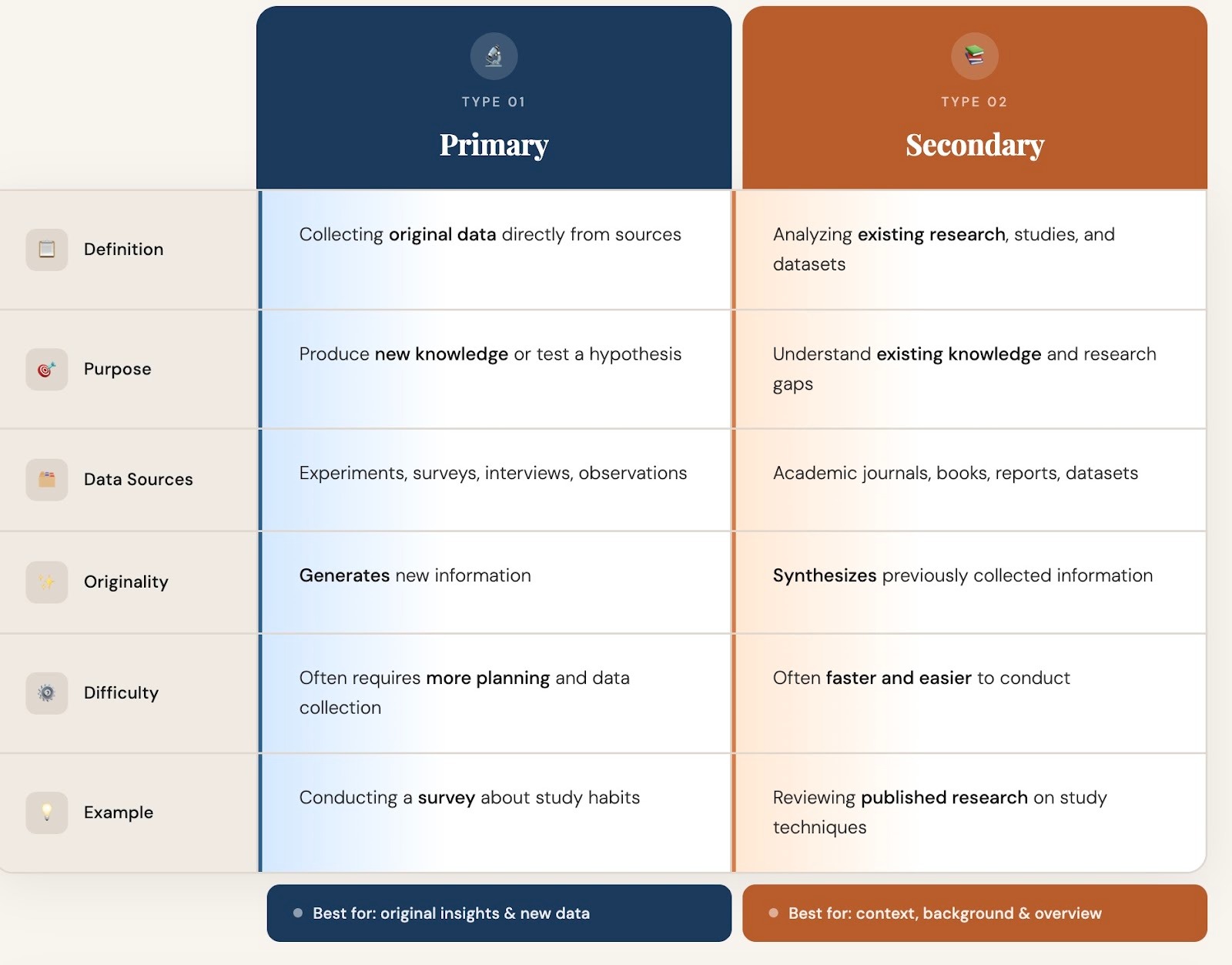
Choosing between primary and secondary research depends on the goals of the project, the research question, and the resources available.
Students should consider primary research when:
Their research question requires specific or new data
Existing studies do not address their exact research context
Direct observations or participant responses are needed
They want to test an intervention or examine real world behavior
Students should consider secondary research when:
They need to understand the current state of knowledge on a topic
They want to identify research gaps before designing a new study
They have limited time or access to participants
They want to analyze large scale datasets that would be difficult to collect independently
In many cases the most effective research projects combine both approaches.
Students in Nova Research Program often begin by conducting a literature review and then design their own primary study based on gaps they identify in existing research.
Strong research projects follow several best practices.
Secondary research should usually come before primary research because reviewing existing literature helps students refine their research questions and avoid duplicating existing findings.
Clearly defined variables improve research quality. Whether students are designing surveys or analysing datasets, they must clearly explain what is being measured and why it matters.
Credible sources strengthen academic work. Peer reviewed journals, academic databases such as JSTOR or PubMed, and trusted research institutions should always be prioritised.
Ethical standards should guide all research involving human participants. Students may need formal approval processes when submitting research to competitions or academic publications.
Proper citation practices maintain academic integrity. Students should follow citation styles such as APA, MLA, or Chicago depending on the requirements of their institution or competition.
Yes. Many high school students conduct primary research through science fairs, independent research projects, and mentorship programs. Surveys, observational studies, and small scale experiments are common ways students gather their own data and test research questions.
Students should use primary research when their question requires new or specific data that does not already exist. This often happens when researchers want to test a hypothesis, measure behavior, or collect responses from a particular group of participants.
Secondary research helps students understand what has already been discovered about a topic. Reviewing existing studies allows researchers to refine their research question, identify gaps in knowledge, and avoid repeating work that has already been done.
Yes. Many strong research projects combine both methods. Students often begin with secondary research to review existing literature and then conduct primary research to collect original data that contributes new insights to the topic.
Developing the ability to choose and apply the appropriate research methodology is an important step toward academic excellence.
Whether a student is launching an original experiment or conducting an in depth literature review, understanding the difference between primary and secondary research allows them to produce credible and meaningful scholarship.
Programs such as Nova Project Labs for middle school students and Nova Research for high school students help students develop these skills through mentorship and guided research design.
Students who engage with both primary and secondary research learn how to ask stronger questions, approach complex problems with rigor, and communicate their findings clearly. These skills extend beyond high school and provide a strong foundation for future academic and professional success.




.webp)

.webp)
