
Competitions
Top Science Fair Project Ideas for High School Students
Discover top science fair project ideas for high school students that stand out to judges, build real research skills, and strengthen college applications.
Read Now
4
minute read


.webp)
Begin your journey to exceptional projects
Test-optional vs Test-blind Admissions Explained: Learn how colleges evaluate SAT/ACT scores and what these policies mean for your college application strategy


Few aspects of the admissions process cause more confusion for applicants than standardized testing policies. Over the past several years, the role of the SAT and ACT has shifted dramatically across the U.S. higher education landscape.
During the COVID-19 pandemic, testing disruptions led more than 1,800 U.S. colleges and universities to adopt test-optional admissions policies, allowing students to apply without submitting standardized test scores. Even as testing access has returned, many institutions have continued these policies. However, the landscape is evolving again. Some universities that previously went test-optional, including Yale and Dartmouth, have announced plans to reinstate standardized testing requirements in upcoming admissions cycles.
Understanding how test-optional and test-blind policies differ is essential for building an effective college application strategy.
This guide explains the difference between the two policies, when students should submit scores, and how applicants can strengthen their profiles regardless of testing requirements.
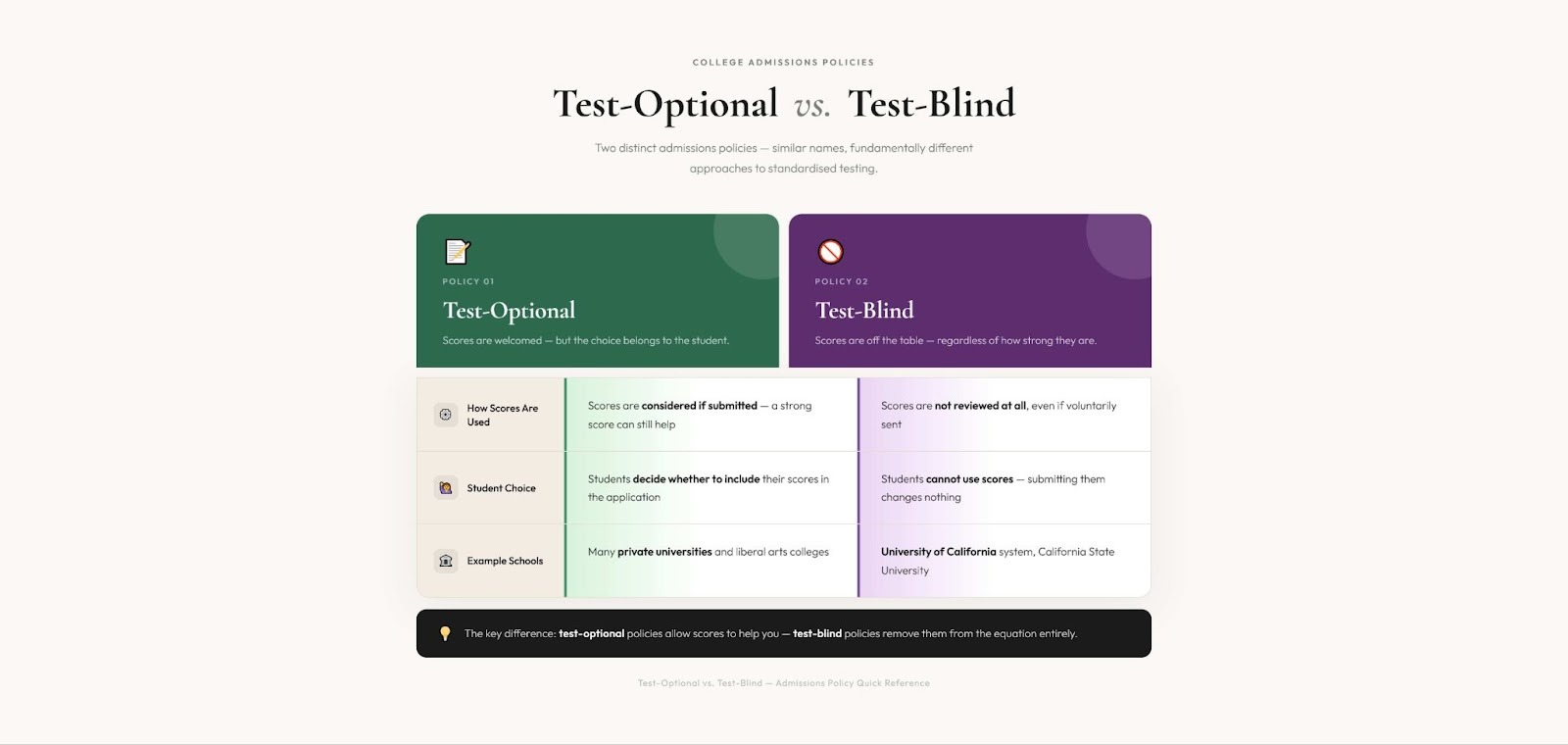
The terms test-optional and test-blind are often confused, but they represent very different admissions policies.
Test-optional admissions allow students to decide whether or not to submit SAT or ACT scores.
Test-blind admissions prohibit admissions officers from considering test scores entirely, even if a student submits them.
Understanding this distinction helps applicants determine how much weight standardized testing will carry in their applications.
At test-blind institutions, standardised test scores are not considered under any circumstances.
Even if a student submits SAT or ACT results, admissions officers are not permitted to review them.
For example, the University of California system and California State University campuses currently follow test-blind policies.
In test-blind admissions, evaluation is based entirely on other factors such as GPA, coursework rigor, extracurricular activities, essays, and recommendations.
Students applying to these institutions should focus on demonstrating intellectual curiosity, leadership, and sustained academic effort rather than standardized test performance.
Under test-optional policies, students can choose whether to submit standardized test scores as part of their application.
If scores are submitted, they are considered alongside the rest of the application. If scores are omitted, admissions committees evaluate applicants based on other academic and personal factors.
Test-optional policies give applicants flexibility but do not necessarily eliminate the value of strong scores.
Students whose scores reflect their academic potential may benefit from submitting them, while others may choose to highlight strengths in research, extracurricular activities, or leadership.
One of the most common questions students ask is whether they should submit test scores when applying to test-optional schools.
Submitting scores can strengthen an application if they fall within or above a school’s middle 50 percent range.
However, scores are not necessary if other elements of the application already demonstrate strong academic ability.
1. Reinforcing Academic Strength
High SAT or ACT scores can provide an additional indicator of academic readiness, particularly at highly selective universities.
2. Differentiating Your Application
In competitive applicant pools, strong test scores can help distinguish students with similar GPAs and extracurricular profiles.
3. Supporting Quantitative Readiness
Scores may reinforce preparation for demanding majors such as engineering, economics, or mathematics.
1. Scores Are Significantly Below the School’s Typical Range
If test results fall well below the middle range of admitted students, submitting them may weaken an otherwise strong application.
2. The Application Demonstrates Strength in Other Areas
Students with strong grades, rigorous coursework, research experience, or leadership roles may benefit from emphasizing those achievements instead.
3. Testing Barriers Affected Performance
Limited access to preparation resources, scheduling challenges, or severe test anxiety can all impact standardised testing performance.
Even in a test-optional environment, standardised test scores remain a useful signal of academic readiness at many institutions.
Admissions committees typically evaluate applications using a holistic review process, meaning they consider a combination of quantitative and qualitative factors.
These may include:
Test scores are rarely the deciding factor in admissions decisions, but strong scores can provide an additional data point when evaluating academic potential.
Regardless of testing policies, authentic experiences remain one of the strongest elements of a college application.
Students who complete independent projects often have more meaningful stories to tell in their essays.
For example, students who conduct original research projects through mentorship programs such as Nova Scholar’s research mentorship program frequently write essays about real intellectual challenges they encountered.
These might include:
Admissions officers recognize the difference between abstract reflection and insights grounded in real academic exploration.
Students who have engaged deeply with a topic often produce essays that demonstrate curiosity, persistence, and intellectual maturity.
The most important takeaway is that standardized tests are now only one part of a much larger admissions picture.
Successful applicants typically present a combination of:
Students should focus on building a compelling narrative about their interests and achievements rather than relying solely on testing outcomes.
Not necessarily. Admissions officers evaluate applications holistically. However, strong scores can strengthen an application when they align with the academic profile of admitted students.
No. At test-blind schools, scores are simply not considered at all. Submitting them does not affect admissions decisions because they are not reviewed.
Testing policies change frequently. As of recent admissions cycles, some Ivy League universities have begun reinstating testing requirements while others remain test-optional. Applicants should always verify each school’s policy on its admissions website before applying.
Research suggests that test-optional applicants are often admitted at comparable rates to students who submit scores, particularly when the rest of the application demonstrates strong academic performance.
The rise of test-optional and test-blind admissions policies reflects a broader shift toward holistic evaluation in college admissions.
While standardized test scores can still provide useful academic signals, they are no longer the sole indicator of a student’s potential.
Students should focus on building a well-rounded application that demonstrates intellectual curiosity, leadership, and meaningful engagement with their interests.
By understanding how different institutions evaluate test scores and by highlighting authentic experiences, applicants can present their strongest possible case for admission.




.webp)

.webp)
